

As a personal trainer, you meet clients with different goals every time. One wants to lose weight, the next wants to join Hyrox and then you have a client who wants a supportive strength program in preparation for the marathon. The client’s goal is leading in how I proceed. One of the choices I have to make is are we going to work with a strength training program, with a hypertrophy program or is a combination possible. With athletes this choice is often easy because then I actually always choose a strength program, but in some cases the choice is not so obvious. Below we will talk more about strength training vs bodybuilding.
When you step into the gym, you often hear two goals: get stronger or build an aesthetic physique. Both require strength training, conscious nutrition and consistency-but the scientific approach behind each goal differs. Understanding the differences will help you train smarter, avoid frustration and possibly even combine both worlds.

Strength Training: Focused on Performance
Definition: Strength training is all about maximum force production-how much weight you can move-in key compound exercises. Strength training is used primarily for athletes who need to get stronger. The emphasis here is not on aesthetics, but purely on increasing strength. This is not saying that it won’t make you look better physically, but this is not the main goal.
Exercise Selection
-
Focus on compound elevators: squat, bench press, deadlift, overhead press, pull-ups.
-
Accessory work targets weak links (e.g. Romanian deadlifts to support your deadlift).
Training Style & Repetitions
-
Intensity: 75-95% of your 1-rep max (1RM).
-
Repetitions & Sets: Usually 1-6 reps, 3-6 sets.
-
Rest periods: 2-5 minutes for full recovery of the ATP-PC energy system.
-
Progression: often linear or nonlinear periodization. Periodization is the systematic planning of your workouts to become progressively stronger or more muscular without becoming stagnant or overloaded.
Effects on the Body
-
Improved neuromuscular efficiency.
-
Greater bone density and stronger tendons.
-
Muscle growth occurs but is not the primary goal, muscles often look more compact rather than “pumped up.”
Nutrition for Strength
-
Energy intake supports training volume and recovery.
-
Carbohydrates are crucial because strength training relies heavily on glycogen.
-
Protein intake of 1.6-2.2 g/kg/day supports recovery and adaptation (Morton et al., 2018).
Now let’s look at bodybuidling so we can see the differences.

Bodybuilding: Focused on Aesthetics
Definition: Bodybuilding is all about hypertrophy: maximizing muscle mass, symmetry and definition.
Exercise Selection
-
Combination of compound and isolation exercises.
-
Exercises load muscles from multiple angles (e.g., side lateral raises for shoulders, curls for biceps).
Training Style & Repetitions
-
Intensity: 60-80% of 1RM.
-
Repetitions & Sets: Usually 8-15 reps, sometimes higher for metabolic stress.
-
Rest periods: 30-90 seconds for increased fatigue and pump.
-
Progression: Volume (sets × reps × weight) is key.
Science fact: Hypertrophy is driven by two mechanisms:
- Mechanical stress (heavy and controlled loading).
- Metabolic stress (accumulation of metabolites during exercise → “the pump”).
It used to be thought that Muscle damage was also a mechanism of hypertrophy, but in 2018, Damas et al. concluded that muscle growth mainly occurs without significant muscle damage once your body gets used to the training stimulus. Effective hypertrophy training is more about progressive overload and sufficient volume than about “breaking” muscle.
Effects on the Body
-
Increase in muscle cross-sectional area (muscle size).
-
Improved muscle definition and symmetry.
-
Greater muscle endurance through higher rep ranges.
Nutrition for Aesthetics
-
Caloric cycles: bulking (surplus) and cutting (deficit). This is a popular technique used by many bodybuilders to speed up the trajectory.
-
Tight macro distribution (proteins, carbohydrates, fats).
-
Protein requirement remains 1.6-2.2 g/kg/day for muscle growth.
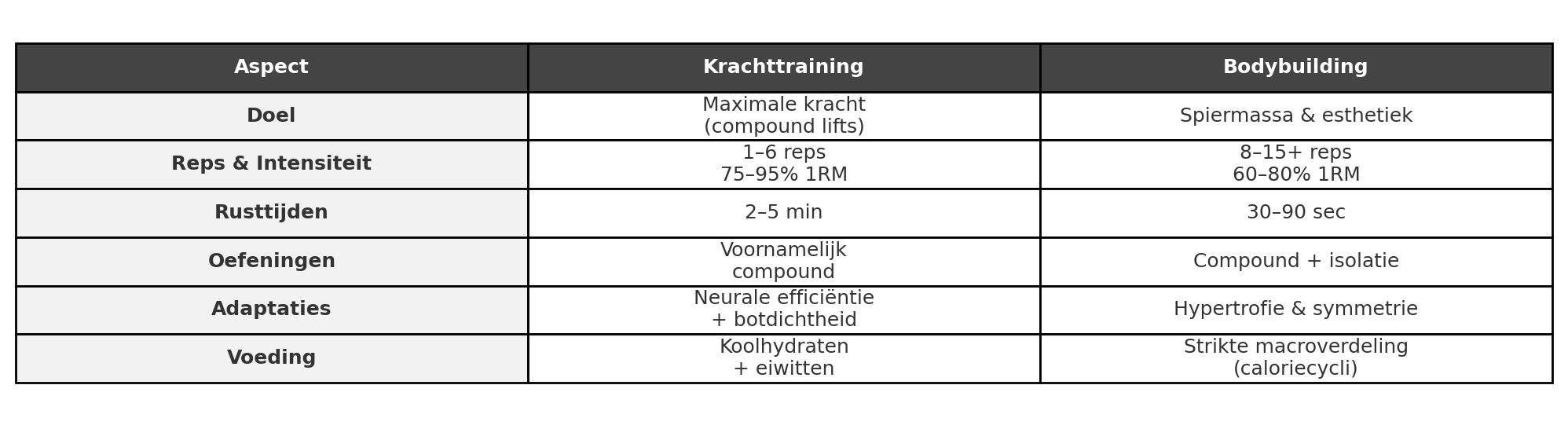
Let’s put them into a table so we can easily see the main differences and similarities:
Which form of training do YOU choose?
-
Choose Strength Training if: you are focused on performance, powerlifting, or simply want to get stronger in everyday life.
-
Choose Bodybuilding if: you primarily want to change your physique-more muscle mass, better symmetry and visible definition.
Can You Combine Both? (Powerbuilding)
Absolutely. A hybrid approach, often called power building, combines the benefits of both:
-
Start your workout with heavy compound elevators (strength focus).
-
Finish with higher-rep isolation exercises (hypertrophy focus).
-
Match your diet to your priority: sufficient energy for recovery and muscle growth, possibly with slight surplus or deficit.
Both strength and hypertrophy depend on progressive overload. Research shows that hypertrophy can occur within a wide rep range, as long as sets are performed to (near) failure (Schoenfeld et al., 2017). There are many different opinions on this.
-
Some studies (e.g., Morton et al., 2016) find that low and high reps are similar in terms of hypertrophy.
-
But other studies show that higher weights (6-12 reps) are slightly more effective for muscle growth, especially for advanced athletes.
Strength and aesthetics are not opposites; they are on the same spectrum of strength training. Getting stronger often makes you look better, while hypertrophy training also makes you stronger. The key lies in your priority: choose whether you prioritize performance or appearance, and adjust your training and nutrition accordingly. You can also cleverly combine them to get the best of both worlds.
Sources:
-
Morton, R.W., et al. (2018). A systematic review, meta-analysis and meta-regression of the effect of protein supplementation on resistance training-induced gains in muscle mass and strength in healthy adults. British Journal of Sports Medicine, 52(6), 376-384.
-
Sale, D.G. (1988). Neural adaptation to resistance training. Medicine and Science in Sports and Exercise, 20(5 Suppl), S135-S145.
-
Schoenfeld, B.J. (2010). The mechanisms of muscle hypertrophy and their application to resistance training. Journal of Strength and Conditioning Research, 24(10), 2857-2872.
-
Schoenfeld, B.J., Grgic, J., Ogborn, D., & Krieger, J.W. (2017). Strength and hypertrophy adaptations between low- vs. high-load resistance training: a systematic review and meta-analysis. Journal of Strength and Conditioning Research, 31(12), 3508-3523.